Getting the Details Right
How the design of the IMO Net-Zero Framework will shape economic outcomes for African states
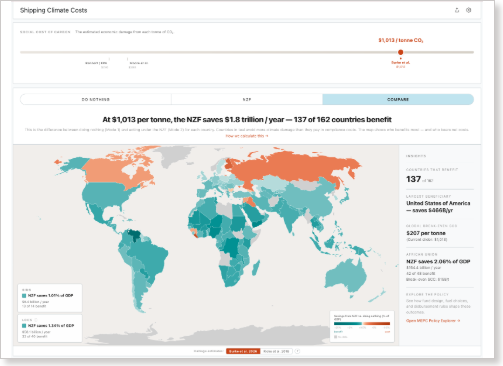
The economic case for shipping's Net-Zero Framework is clear at the global level. At any science-based estimate of climate damage, the NZF pays for itself. The avoided damage from decarbonizing international shipping exceeds the compliance costs by a wide margin. Across the 49 African Union member states, the NZF reduces total economic burden from 2.88% of GDP under inaction to 0.81% under the Framework, a reduction of more than two-thirds. (For the full global analysis, see The Economics of Shipping's Climate Choice.)
But "the NZF is worth it" is the beginning of the conversation, not the end. Six competing proposals are now on the table at the IMO, and they fall into two groups. The NZF and its close variants would decarbonize shipping through binding emissions targets and a compliance pricing mechanism, generating revenue that flows back to developing economies through an IMO Net-Zero Fund. The alternative proposals, from market-linked frameworks with no pricing mechanism, to renegotiation from scratch, to the United States' position of ending the process entirely, would do little or nothing to reduce emissions and have no fund mechanism at all.
For African states, this distinction matters on both sides of the ledger. The proposals that weaken or abandon the NZF leave shipping emissions unabated, meaning the climate damage continues to fall disproportionately on African economies. And they eliminate the Fund, removing the only mechanism through which compliance revenue is recycled back as transition support, infrastructure investment, and food security mitigation. African economies lose twice: they keep bearing the cost of inaction and they lose access to the resources that would help offset the cost of action. (The MEPC Policy Explorer's Pathways module compares all six proposals side by side.)
Assuming the NZF or a close variant prevails, the question shifts from whether African economies will have access to a transition mechanism to how well that mechanism works. And that depends on design choices that are still under negotiation: what share of Fund revenue goes to rewards versus disbursements, which countries are eligible for disbursement, in what form disbursements arrive, and how rewards are calibrated. These details may appear technical, but they carry significant economic consequences for African economies.
This brief presents findings from a reduced-form economic impact model that links specific NZF design choices to measurable GDP, consumer price, and trade cost impacts across African economies. The model builds on the IMO's own Comprehensive Impact Assessment (MEPC 82/INF.8/Add.2, Scenario 24) and has been validated against its results. Unlike analyses that compare broad policy packages, this approach isolates the effect of individual design parameters, enabling African delegations to assess the economic implications of specific negotiating positions.
The findings are clear: the NZF's cost burden on African economies is real, but moderate and manageable. The most consequential design decision is how the IMO Net-Zero Fund's revenue is divided between rewards for ship operators and disbursements to developing countries. And even the most favorable design architecture will fail to deliver its benefits if the Fund is not operational when the Framework takes effect.
What is the NZF and why do design details matter?
The IMO Net-Zero Framework is the regulatory package agreed by IMO Member States to decarbonize international shipping. Its core components are a greenhouse gas fuel intensity standard that progressively tightens over time, a two-tier compliance mechanism through which ships that exceed emission limits must purchase remedial units, and an IMO Net-Zero Fund that collects the resulting revenue and deploys it through two channels: rewards for ship operators using zero and near-zero emission fuels, and disbursements to developing countries to support an equitable transition.
The analysis focuses on five representative African economies — Ghana, Kenya, South Africa, Egypt, and Ethiopia — selected for their diversity of economic structure, trade exposure, and vulnerability profile. Results are additionally reported for a broader group of fourteen African economies and the African Union bloc. The model covers all economies with individual breakouts in the CIA results and can be applied without structural modification to any country or grouping within that dataset.
The economic impact on Africa: real, but bounded
The NZF will increase the cost of international shipping. This cost increase flows through to African economies primarily via higher import prices, which in turn affect consumer prices and GDP. The magnitude depends on the specific design configuration adopted, but across the full range of plausible outcomes, the aggregate impact remains bounded.
At the 2030 horizon, where analytical confidence is highest, global maritime logistics costs are estimated to increase by between 7.7% and 8.6%, depending on the design choices made. For the five African reference economies, this translates into GDP impacts ranging from approximately −0.05% to −0.19%. These are small in percentage terms but meaningful in absolute value, and they fall disproportionately on the most trade-exposed economies. The weighted average GDP impact across the five African reference economies is roughly 2.6 times larger than the impact on India and 2.3 times larger than the impact on all developed economies.
Consumer price effects follow a similar pattern. Countries with high dependence on seaborne food imports, notably Morocco, Madagascar, and Egypt, face disproportionate food price exposure. Trade costs increase most for economies whose import baskets are weighted toward commodities with high maritime transport margins.
Critically, by 2050, all policy scenarios converge to a narrow range of maritime logistics cost increases regardless of the design choices made today. Design choices primarily affect the transition period between now and 2040. It is during this window that the right design decisions can meaningfully reduce the cost burden on African economies.
The decisive design lever: how Fund revenue is allocated
Among the many design parameters in the NZF, one dominates: the share of Fund revenue directed to rewards for ship operators versus disbursements to developing states. This single parameter, the Fund revenue split, has the largest effect on African economic outcomes because it simultaneously affects both sides of the equation: a higher reward share increases the compliance cost borne by the global trading system, while reducing the pool of funds available to offset that cost for developing countries.
All other design parameters, including reward calibration, fuel eligibility rules, and compliance unit market design, collectively affect GDP by less than one percentage point of maritime logistics cost increase. These parameters matter for the effectiveness and efficiency of the NZF's core environmental objective: how well the reward mechanism incentivizes the production and uptake of zero and near-zero emission fuels. But their influence on the macroeconomic outcomes that concern African economies is secondary to the Fund revenue split.
The table below illustrates the practical consequences. It shows the estimated net GDP impact in 2030 for five African economies under three negotiation scenarios, each representing a coherent package of design choices — from an outcome favorable to African interests, to a compromise, to an unfavorable outcome.
Table 1: Estimated net GDP impact in 2030 under three negotiation scenarios (% of GDP)
| Scenario | Ghana | Kenya | South Africa | Egypt | Ethiopia* |
|---|---|---|---|---|---|
| Africa-Favorable | −0.063 | −0.111 | −0.083 | −0.096 | −0.014 |
| Compromise | −0.078 | −0.147 | −0.090 | −0.109 | −0.031 |
| Africa-Unfavorable | −0.094 | −0.186 | −0.097 | −0.123 | −0.025 |
*Ethiopia is represented through a composite of landlocked African economies. Under "Africa-Unfavorable," SIDS/LDC-only eligibility excludes Ghana, Kenya, South Africa, and Egypt from disbursements entirely but continues to include the Ethiopia composite.
Source: Fourth Tack MEPC Policy Explorer (NZF Design module), based on IMO Comprehensive Impact Assessment, MEPC 82/INF.8/Add.2, Scenario 24.
Several features of this table are worth noting. For Kenya, the difference between favorable and unfavorable outcomes amounts to 0.075 percentage points of GDP, a substantial margin driven primarily by the revenue split and eligibility rules. For Ghana and Egypt, the gap is similarly significant. South Africa's range is narrower because its more diversified economy is less exposed to the maritime cost channel.
The Ethiopia result highlights a structural feature of the allocation design. Because the Ethiopia composite includes Least Developed Countries, it remains eligible for disbursement even under the most restrictive eligibility rules. When disbursement is concentrated on fewer eligible countries, LDC recipients can actually receive a larger per-country allocation. This is not the case for middle-income African countries like Ghana, Kenya, and Egypt, which lose their entire offset under restrictive eligibility.
This finding has a direct implication for negotiating strategy: securing broad eligibility for disbursement is as consequential as securing a favorable revenue split, particularly for Africa's middle-income economies.
The implementation imperative
Even the most favorable design architecture will deliver no near-term benefits to African economies if the IMO Net-Zero Fund is not operational when the NZF takes effect. The analysis models this risk explicitly by testing what happens if the Fund's disbursement channel is non-functional at 2030.
The result is stark: the economic impact reverts to the full compliance cost shock with no fiscal offset, regardless of how favorable the design choices on paper may be. In quantitative terms, the difference between a functioning and a non-functioning Fund at 2030 is comparable to the entire range of variation across all policy design parameters. An NZF with generous disbursement rules but no operational Fund is economically equivalent to an NZF with no disbursement at all.
This finding supports treating early Fund operationalization as a negotiation objective of equal importance to the revenue split and eligibility rules. Governance arrangements, interim mechanisms, board composition, and administrative readiness all contribute to whether the fiscal offset channel functions as designed, and each is under negotiation in the current phase.
Conclusion
The NZF will impose real costs on African economies, but the magnitude of those costs, and the extent to which they are offset, depends critically on design choices that are still under negotiation. African delegations have a window to shape the outcome.
Three priorities emerge from the analysis. First, the Fund revenue split is the single most consequential design parameter and should be a central focus of negotiating effort. Second, broad eligibility for disbursement is essential. Restricting access to SIDS and LDCs alone eliminates the fiscal offset for the majority of African economies. Third, the Fund must be operational from the outset; without it, no design choice delivers its intended benefit.
The economic evidence presented here is intended to support African delegations in making informed, evidence-based arguments in the negotiations ahead. The stakes are in the details.
Explore the evidence
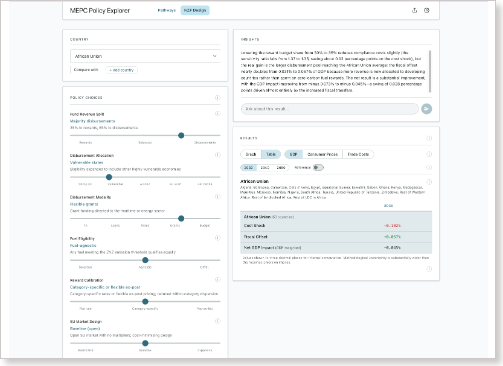
The MEPC Policy Explorer - NZF Design module implements the identical computation chain described in this brief, allowing users to adjust each design parameter and observe the resulting GDP, consumer price, and trade cost impacts for individual countries in real time. A Pathways module compares six competing policy proposals currently on the table at the IMO. Full methodology documentation is available.
Shipping Climate Costs — look up the cost of climate inaction for any country, adjust the SCC, and compare against the NZF. 163 countries, three modes (Do Nothing / NZF / Compare), Burke and Ricke damage weight toggle.
MEPC Policy Explorer — compare six IMO policy proposals and model how NZF design choices (Fund revenue split, eligibility rules, disbursement efficiency) affect economic outcomes for specific countries.